Thinking Literacy™
Thinking Literacy is a research-informed framework for helping educators intentionally cultivate human thinking through learning experiences that develop understanding, reasoning, judgment, and independence over time.
As AI changes how learners access information and produce work, the framework offers an approach to designing meaningful learning experiences and recognizing evidence of developing capability across disciplines.
Developed by educator and author Velma Itamura, the framework also informs the work of the Science & Technology Advancement Center (STAC).
Why Thinking Literacy?
Education has always carried a responsibility to help learners develop the understanding, reasoning, and judgment needed to navigate an increasingly complex world. The availability of artificial intelligence has made that responsibility more urgent.
When AI can generate sophisticated explanations, analyses, solutions, and other academic products, a completed assignment may provide limited evidence of what a student understands, how they reason, or what they can accomplish independently. Educators need purposeful ways to cultivate human thinking and recognize its development, whether or not AI is used.
Cultivating Human Intelligence
Thinking Literacy draws on research about human learning and cognition. It considers how meaningful challenges, disciplinary knowledge, evidence, reflection, and repeated opportunities to exercise judgment contribute to the development of increasingly capable thinkers.
Curiosity, intellectual humility, openness to evidence, and the ability to examine competing ideas influence how learners approach uncertainty. Metacognition helps learners monitor their understanding, reconsider assumptions, and make informed decisions about how to proceed.
Thinking Literacy Across Disciplines
Thinking Literacy applies across subject areas while recognizing that each discipline uses different forms of knowledge, evidence, reasoning, and judgment.
Science
Investigate phenomena, analyze data, evaluate explanations and models, and support or revise conclusions using evidence.
Mathematics
Examine patterns, justify strategies, test conjectures, evaluate solutions, and revise reasoning.
Social Studies
Analyze sources in context, consider competing interpretations, and develop evidence-based judgments.
English Language Arts
Interpret texts, evaluate arguments, consider alternative perspectives, and develop and revise interpretations.
Its applications also extend to the arts, technology, and other fields where learners must weigh evidence, evaluate choices, and exercise judgment.
From Framework to Educational Practice
Intentionally cultivating human intelligence requires attention to the thinking students need to develop, the conditions under which they learn, and the evidence that reveals their growing capabilities.
Intentional Learning Design
Identify consequential intellectual work and create learning experiences that develop understanding, reasoning, and judgment.
Evidence of Learning
Examine what student performance reveals about thinking and understanding, including how support and tools shaped the work.
Development Over Time
Provide connected opportunities for increasingly sophisticated thinking, stronger judgment, independence, and transfer.
What might this look like in science?
Consider an investigation of changes in stream turbidity after heavy rainfall. Students may produce accurate graphs and explanations, but their reasoning becomes more visible when they interpret patterns, examine uncertainty, consider alternative explanations, and identify additional evidence that could change their conclusions. The Science and Engineering Practices offer meaningful opportunities to design for and observe that thinking.
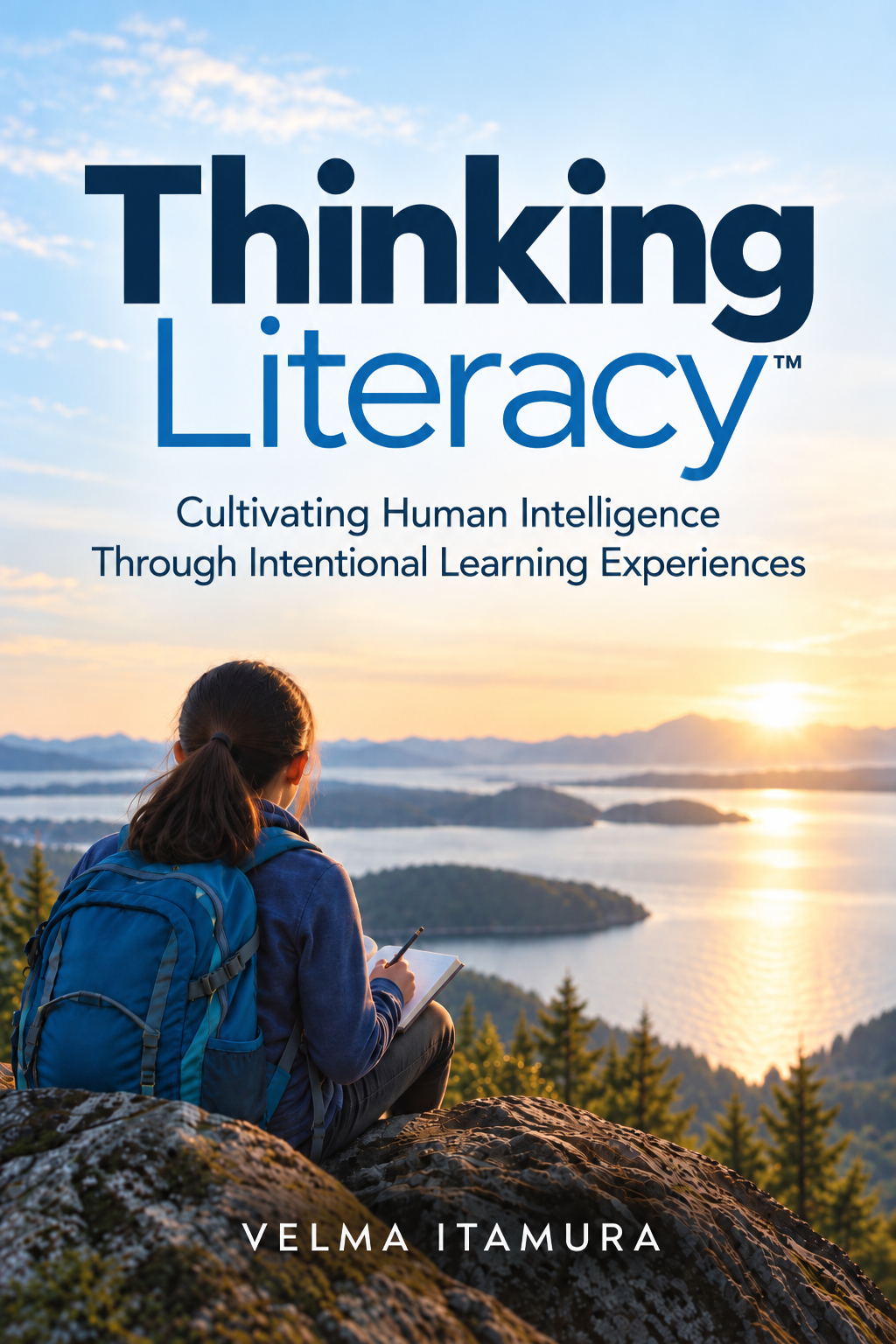
Thinking Literacy
Cultivating Human Intelligence Through Intentional Learning Experiences
By Velma Itamura
The forthcoming book explores the research-informed foundations of Thinking Literacy and the implications for learning design, assessment, technology, professional learning, and educational systems. It examines how educators can intentionally develop understanding, reasoning, judgment, and independence across disciplines and over time.
Be among the first to know when the book is published.
Sign Up for Publication Updates
Publication details coming soon. Signups are optional and separate from NSTA session resources.
About the Framework Developer
Velma Itamura is an educator, author, and co-founder of STAC, with approximately 30 years of experience in science education, curriculum, assessment, and educational leadership. Her experience includes classroom teaching, state-level education work, and educational assessment. She developed Thinking Literacy as a coherent, research-informed foundation for intentionally cultivating human thinking across disciplines.
Explore Thinking Literacy at NSTA Indianapolis
Connect with STAC at the STEM Showcase and explore how Thinking Literacy informs science learning through our joint Vernier session and three-part STAC pathway.
When AI Has the Answer: Designing Science for Thinking Literacy
Wednesday, November 4, 2026 · 3:15 PM · Room 235
Explore how firsthand investigations and the Science and Engineering Practices help students analyze evidence, evaluate explanations, and make their scientific reasoning visible when AI can generate polished answers.
Browse the NSTA conference sessions for the Vernier + STAC session →
Using the SEPs to Design AI-Resilient Science Tasks
Design meaningful opportunities for disciplinary reasoning through the Science and Engineering Practices.
Using AI as a Reasoning Partner: SEP-Based Routines for Scientific Sensemaking
Explore how AI can support scientific sensemaking while students exercise evidence-based judgment.
Assessing Student Reasoning in AI-Resilient Science Learning
Consider what counts as evidence of student understanding when tools can produce the final product.