AI Literacy Is Not Tool Literacy

AI literacy is about more than learning how to use new tools. In this article, STAC explores why AI literacy should be grounded in critical thinking, evidence evaluation, reasoning, and informed decision-making. As AI tools continue to change, students need durable skills that help them question outputs, make sense of information, and participate thoughtfully in an AI-shaped world.
By Velma Itamura, Operations Director
May 15, 2026

AI Literacy Is Not Tool Literacy
AI literacy is Thinking Literacy™, grounded in critical thinking, evidence evaluation, and informed citizenship.
AI literacy is becoming one of the most urgent conversations in education. Schools and districts are trying to respond to a rapidly changing landscape, and educators are being asked to learn new tools, develop policies, prevent misuse, and prepare students for a future that is already here.
But in many conversations, AI literacy is still being defined too narrowly. Students may learn how to write a prompt, generate a response, summarize information, brainstorm ideas, or produce something faster. Those skills are useful, but AI literacy should also help students question, evaluate, reason, and make informed decisions.
At STAC, we keep coming back to a deeper question: What does it mean for students to think well in a world where tools can generate information, explanations, images, arguments, and answers with increasing speed and confidence?
For us, AI literacy must be grounded in critical thinking, evidence evaluation, disciplinary reasoning, and informed decision-making. Put another way, AI literacy is Thinking Literacy™. It is about helping students question information, evaluate evidence, challenge claims, and use AI with intention. It should help students ask better questions, examine claims, identify what is missing, evaluate evidence, and decide when an AI-generated response is useful, incomplete, misleading, or wrong. When framed this way, AI literacy becomes less about technology itself and more about preparing students to be thoughtful learners, informed citizens, and capable contributors in a changing world.
AI literacy is becoming a workforce and education priority
The conversation around AI literacy now extends beyond classrooms into workforce readiness and education policy.
In February 2026, the U.S. Department of Labor released an AI Literacy Framework to guide AI literacy efforts across workforce and education systems. The framework identifies foundational content areas and delivery principles that can inform program design across roles, industries, educational sectors, and workforce contexts.
For schools, this matters because AI literacy is becoming part of workforce readiness. It cannot be treated as an optional technology add-on or a skill reserved for certain courses. Students need opportunities to develop the habits of mind that allow them to use AI thoughtfully, ethically, and critically.
This does not mean every classroom needs to become a technology class. It means every classroom has a role to play in helping students reason with information, evaluate claims, make decisions, and communicate their thinking.
Tool fluency is not the same as thinking fluency
Tool fluency can create the appearance of understanding without giving us real evidence of student thinking. A student may produce a polished AI-supported response, but still miss the concept, overlook unsupported claims, or fail to show how the response was evaluated, revised, or justified.
This is why AI literacy cannot stop at productivity. When AI is used mostly to make work faster, it can unintentionally bypass the very thinking we want students to develop. Students may get to an answer more quickly, but that does not mean they have wrestled with the question, constructed understanding, or revised their ideas.
For educators, this is the core issue. The question is not simply whether students can use AI. The more important question is how we design learning experiences that require students to think.
AI literacy should make student thinking more visible
One of the most important shifts schools can make is to focus less on whether students used AI and more on what evidence we have of student thinking. The goal is not simply to determine whether AI was involved. The goal is to understand what students noticed, questioned, evaluated, revised, and justified along the way.
This means looking beyond the final product. Did the student ask a meaningful question? Did the student compare the AI output to data, text, observations, or prior learning? Did the student identify what was accurate, what was unsupported, and what needed revision? Did the student explain why they accepted, rejected, or modified the response?
A classroom focused on AI literacy asks students to make this kind of reasoning visible through annotations, evidence trackers, revision notes, model changes, comparison charts, reflection prompts, or short explanations of how students made decisions. The format can vary, but the purpose is consistent: students need to show how they thought, not just what they produced.
Science education offers a strong foundation for AI literacy
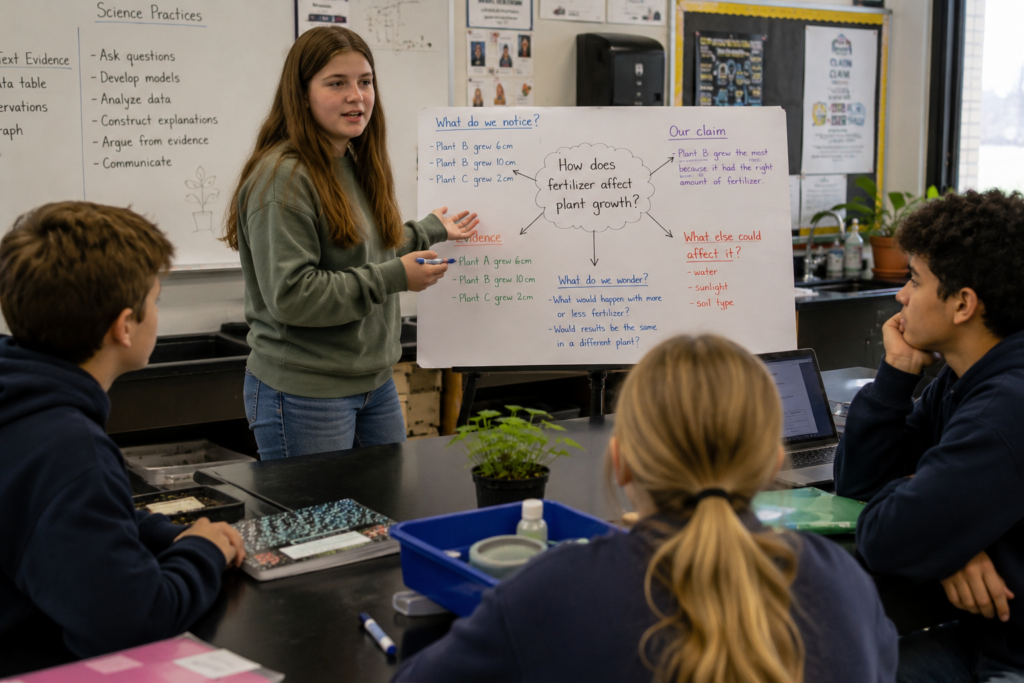
Science classrooms are especially well positioned to support AI literacy because science education already has a strong structure for making student thinking visible.
The Science and Engineering Practices ask students to do the work of sensemaking. Students ask questions, develop and use models, analyze and interpret data, construct explanations, engage in argument from evidence, and communicate information. These practices are not just science skills. They are thinking skills that help students build the habits of mind they need in an AI-rich world.
In a science classroom, students are regularly asked to make their thinking public. They identify the question they are trying to answer, examine the evidence that supports a claim, decide whether an explanation fits the data, critique what may be missing or unsupported, and revise their thinking when new evidence emerges. Those same habits are essential when students interact with AI-generated information.
This is why STAC sees AI literacy and science sensemaking as deeply connected. AI can support learning, but only when the task design keeps reasoning with the student. The goal is not for AI to do the thinking. The goal is for students to use AI as one input they must evaluate, question, test, and refine.
AI literacy is also about citizenship
The need for AI literacy extends well beyond workforce readiness. Students are growing up in a world where AI-generated information will shape what people read, see, believe, share, and act on. They will encounter AI-generated explanations, images, recommendations, summaries, and claims across social media, search engines, workplaces, civic life, and personal decision-making.
In that world, students need more than access to AI tools. They need the intellectual discipline to pause, question, and evaluate what they are seeing. They need to understand that confident language is not the same as accuracy, a polished explanation may still be incomplete, and data can be misrepresented. They also need to ask whose perspectives are included, whose perspectives are missing, and what evidence is being used to support a claim.
AI literacy should help students become less passive as consumers of generated content and more careful as thinkers, decision-makers, and participants in civic life. Critical thinking, disciplinary reasoning, and informed citizenship should be at the center of AI literacy.
What this means for educators and education leaders
For educators and education leaders, the work ahead is about more than choosing tools or writing acceptable use policies. Those decisions matter, but the deeper work is instructional.
Students benefit from classroom routines, tasks, and assessments that keep reasoning at the center. AI use should be purposeful, productive struggle should be protected, and students should be asked to explain how they questioned, evaluated, revised, or justified their thinking. This also requires professional learning that helps teachers build classroom cultures where AI use is intentional, transparent, and open to critique.
This requires a shift in how AI literacy is framed. Instead of starting with what a platform can do, schools can start with the reasoning students need to develop. From there, AI becomes something to design around thoughtfully: a resource that may support, challenge, or reveal student thinking, depending on how the learning experience is structured.
How we frame AI literacy shapes the choices schools make. When the focus begins with the tool, conversations tend to center on platforms, features, and policies. When the focus begins with student thinking, the work shifts toward designing learning experiences that help students question, evaluate, reason, and communicate more clearly.

The opportunity ahead
AI will continue to change rapidly. The tools students use today may not be the tools they use five years from now. Specific platforms will evolve, disappear, or be replaced.
What will remain is the need for students to think critically, evaluate evidence, reason carefully, communicate clearly, and make informed decisions. If we want AI literacy to last beyond the next platform, we have to build it around durable thinking skills. That is why AI literacy must be grounded in more than tool training.
At STAC, we believe AI literacy should prepare students to think deeply, question carefully, reason with evidence, and participate thoughtfully in the world around them. Put simply, AI literacy is Thinking Literacy™.
As AI tools continue to change, those habits of mind will become even more important. Schools need intentional learning designs that help students build them. That kind of design requires professional learning, classroom routines, and assessment approaches that keep student reasoning at the center.
Ready to build AI literacy around student thinking?
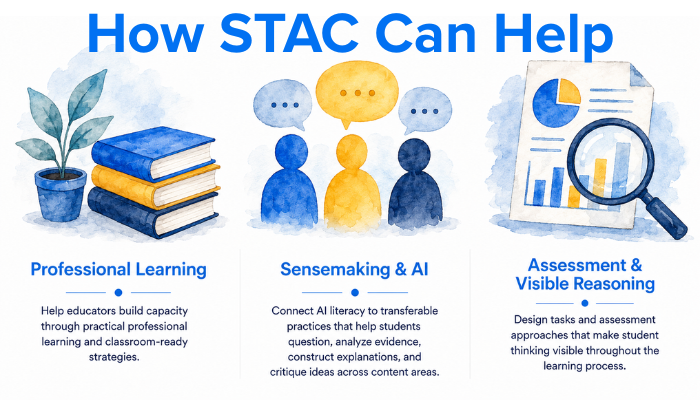
STAC helps schools, districts, and education organizations design professional learning, classroom routines, and assessment approaches that keep student reasoning at the center of AI use.
Whether you are developing AI guidance, planning professional learning, or redesigning classroom tasks, we can help educators use AI with purpose, transparency, and critique.
About the author
Velma Itamura is Operations Director of STAC, where she supports schools, districts, and education organizations in science education, assessment, professional learning, accessibility, and AI literacy.